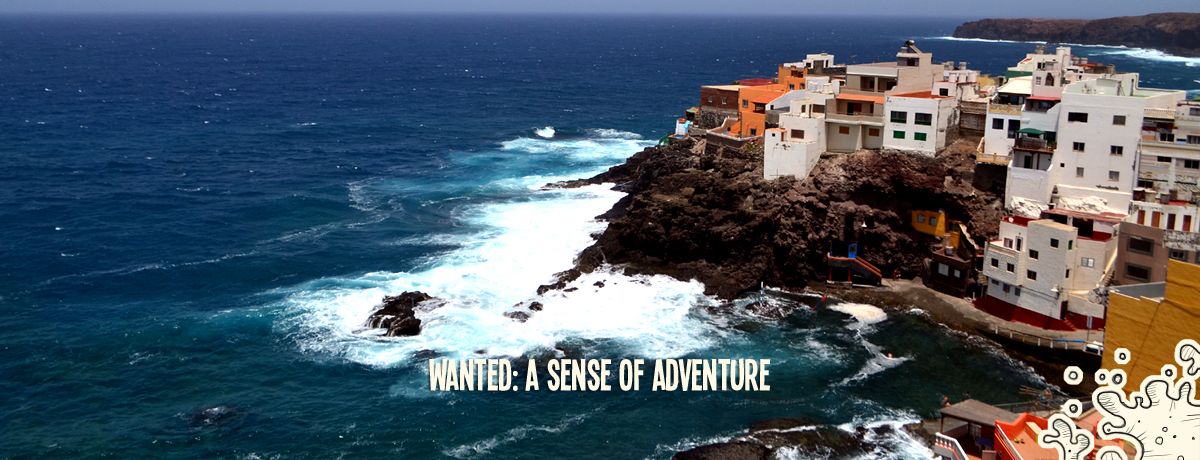
If you want to take a dip near Gáldar, you only need to roll the dice. Luck is on your side. You cannot go wrong, for right beside the road appears a coastline filled with small coves, wrapped in the salty air of Gran Canaria’s northern shore.
Places such as Caleta de Arriba, El Agujero, Dos Roques, La Furnia, Punta de Gáldar and Sardina. In the municipality of Gáldar we find a complete route of coastal corners that fill the maps, offering you the finest of swims.
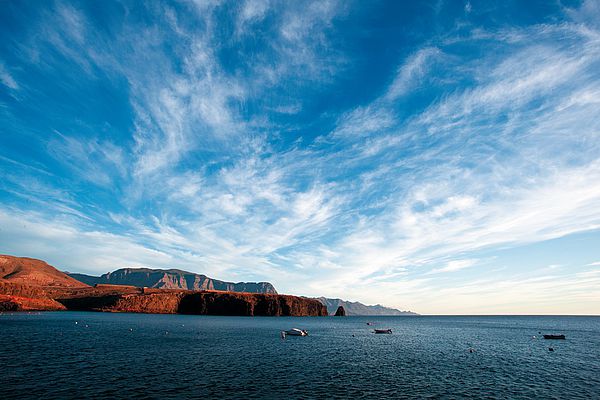
The entire coastline of the municipality is dotted with nooks that live facing the sea. These small beaches, coves and natural pools rarely become crowded. Tranquillity is the norm. You may find more or fewer people depending on the time of year or the day of the week, but you can always enjoy their beauty at an unhurried pace.
To those who love hidden places, the coast of Gáldar has a unique charm, a special character. The Atlantic Ocean flows into every corner, bringing joy to the lives of fishermen and surfers.
For here the sea makes its presence felt.
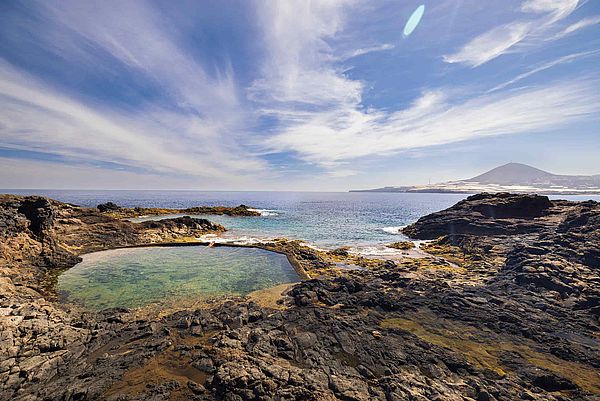
But do not worry, swimming is guaranteed. Barriers and protective walls have been built to make bathing safe and calm. Natural pools and sheltered coves await us along the entire coast. In addition to the popular charcos, those sea pools that dot the rocky coastline and fill with each rise and fall of the tide.
The human landscape of these beaches does not change. It is always the same, from generation to generation. Children are happy in the old-fashioned way, splashing and playing among maritime tools that recall trades slowly fading into memory as the years go by.
Here, even the ice-cream seller goes against the current. He visits the coves one by one and still announces his arrival with the cheerful call of his offers. The ice-cream man carries a cool box full of Bakokas, the traditional ice creams that he sells for just over a euro.
And that is the plan. Do not look for anything more complicated: quiet beaches, good old-fashioned ice cream and calm swimmers at the edge of seafaring villages. We can round off the afternoon with a fish barbecue or by waiting to watch the sunset fall.
But the municipality of Gáldar offers more than sea bathing. The north of Gran Canaria is an essential route for anyone interested in the island’s pre-Hispanic culture. You will find several points of interest, although among the archaeological treasures stand out the Cueva Pintada, the Poblado del Agujero and the Necrópolis de La Guancha, all of them references to the island’s ancient history.
The first of these, the Cueva Pintada Museum and Archaeological Park, tells in an engaging way the story of the island’s earliest inhabitants. It is a centre of reference for the study of pre-Hispanic Gran Canaria and the turbulent events that culminated in 1483 with its incorporation into the Crown of Castile.
The Cueva Pintada is the finest and most complex example of indigenous mural painting in Gran Canaria, and the walk through the site allows visitors to imagine the structure and rhythm of life within that community. It includes a large area dedicated to the reconstruction and recreation of indigenous dwellings.
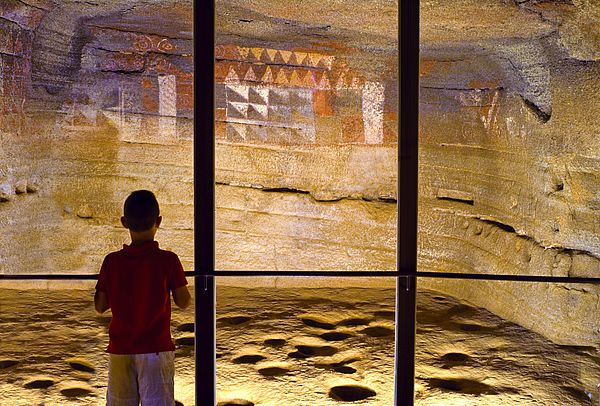
The Necrópolis de La Guancha is another site open to visitors. It represents one of the largest concentrations of houses and burial mounds in this part of the island, whose original extent would have covered a much greater area than what is preserved today.
In Gáldar we can also visit the Casa-Museo of the painter Antonio Padrón, one of the most distinctive artists in twentieth-century Spanish art. His museum holds much of the artist’s work.
The painter’s influence is also found outside the museum, where we encounter references to his work, such as the replica of El Rayo Verde that decorates the Mirador del Pescador, on the road to Caleta de Arriba.
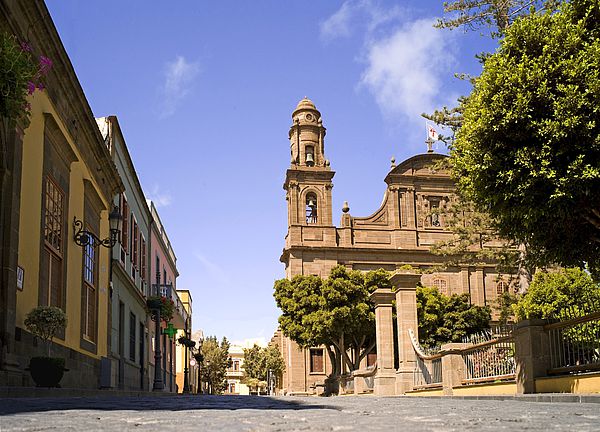
Other interesting buildings include the Town Hall, with its centuries-old dragon tree considered the oldest on the island, the Casa Verde de Aguilar and the Casa del Capitán Quesada. Yet standing above them all is the Church of Santiago de los Caballeros, which marks the end of the island’s Jacobean route, the Camino de Santiago of Gran Canaria.
From Las Palmas de Gran Canaria, the capital located in the northeast, take the Northern Main Road towards Gáldar.
After about thirty minutes along the GC-2, you will reach Gáldar. It is easy to find the Antonio Padrón Museum, right in the centre, within the old town.
To draw closer to the coast of the municipality, we must venture into the maze of greenhouses that cover forty-four per cent of the cultivated land.
But if you wish to take a simpler route, follow the road until you find the exit marked ‘Sardina del Norte’. Then continue on the GC-202 until the junction indicating the turn-off to the archaeological site of La Guancha, beside which lie the natural pools of El Agujero.
Along that route you will find turn-offs and access roads leading to the other enclaves, Dos Roques, Caleta de Arriba and La Furnia.
If you wish to continue to Punta de Gáldar, stay on the GC-220 until you see the signposted turn further ahead.
The paths separating the plots, mostly paved, are narrow and it is easy to lose one’s sense of direction. Although the route is scattered with signs bearing the names of the various coves and bathing spots. Beginning the coastal path from Caleta de Arriba lets you skirt the shore westward and discover each of its hidden corners. The people of the area are warm and welcoming and will be delighted to help if needed.
An example of the typical stately Canarian houses, the house-museum is entered through a hallway that leads to an open courtyard.
Around it are arranged the various rooms of the building, now converted into museum galleries with spaces recreating the home of Néstor Álamo and others devoted to the History of Music in the Canary Islands. It stands in the neighbouring municipality of Santa María de Guía, on Calle San José.
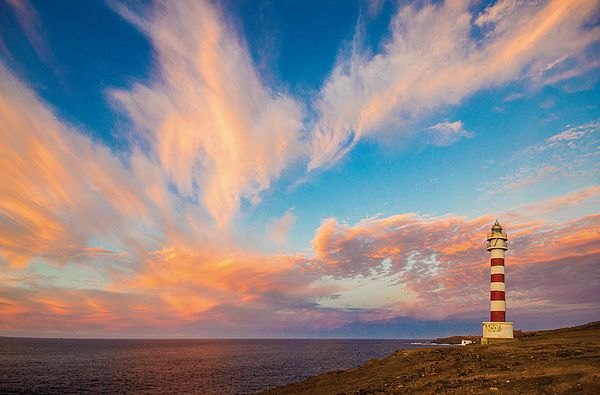
Majestic and commanding. Rising at the island’s far northern edge, stands the Punta Sardina Lighthouse. A few kilometres away from the village stands this luminous giant, once responsible for guiding maritime navigation along these north-western coasts of the island until not so many years ago, illuminating the stretch between Punta de la Aldea and La Isleta.
This solitary red-and-white titan has been the subject of countless photographs taken each day by visitors as the sunset falls behind it. Undoubtedly, one of the most well-known postcards of Gran Canaria.
To wander through the narrow lanes of El Roque is to begin to shed layers, to leave behind what is superfluous. After a short stroll along its narrow streets, the sea comes into view. A sea that gives life to this place. We are on the northern coast of Gran Canaria, specifically in the municipality of Moya.
El Roque bears witness to times when every patch of fertile land was worked, and houses were built in impossible places, wherever it was not possible to cultivate. To climb its steep slope today is like leaping into another time, to the place you choose to travel to, rocked by the history of a place like this, three hundred and twenty metres out to sea.