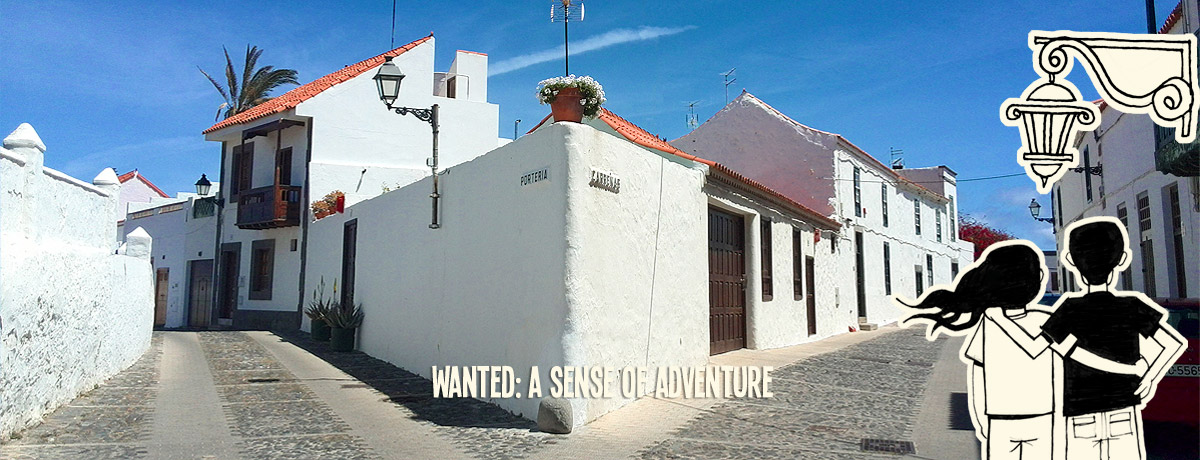
The more curious traveller will quickly understand that San Francisco is much more than a small cluster of narrow streets in the city of Telde. This neighbourhood drops hints of its history at the feet of the wanderer as they make their way through it. Signs that come forth to meet you, to speak of the past. One of the most picturesque and best-preserved corners of eastern Gran Canaria.
Many crosses placed along a circular route, its monteras, and the names of its streets are symbols that piece together the origins of San Francisco. A neighbourhood of artisans, a former Jewish quarter once inhabited by those who worked for the bourgeoisie of the nearby historic district of San Juan, where the Christians were settled.

The only original entrance to San Francisco is located on Calle Carlos E. Navarro. From here, the route seems to lead you on a small, timeless journey through the alleys named by the poet Julián Torón. Modern notes and older echoes guide the explorer to a meeting point where present and past intertwine.
Along the way we find numerous crosses of the Via Crucis, in honour of the Franciscans who settled here in 1610. Each one is placed in its original spot. A blend of preservation, restoration, and respect for the past. Each is different; you will not find two alike, and every one tells its own story.
A little further ahead we come across the house of Julián Torón, a prominent figure of the city, member of Telde’s Lyric School, who enriched and energised the culture of his time in the city. You will also see an impressive Indian laurel tree, more than 70 years old, right where the five main streets that shape this cobbled corner converge.

Along the way we stumble upon some of the five monteras that still remain. Three steps upon a small mound, jutting out at the foot of façades that today seem purposeless, yet in times not so distant served to help riders mount their horses.
In the Plaza de los Romeros the view opens out. An open space where we can take in a wider panorama of our surroundings. For if you lean out from the viewpoint, besides the archaeological sites of Tara and Cendro to your left, you will see to your right the Seven Eyes Bridge, which spans the Telde ravine. This bridge was built in 1868 by Juan de León y Castillo, a renowned architect in the history of Gran Canaria.

To reach our destination we must take the GC-1 towards Telde and exit onto the GC-10 until we reach the town. Following the signs, we can park close to the San Francisco neighbourhood without any problem.
Together with Gáldar, it was an important centre in the island’s prehistory. Located very close to the capital, on the eastern side of the island, it is the second most populated municipality of Gran Canaria and one of the main urban and industrial hubs of the archipelago.
In terms of its ethnographic value, we find more than a hundred archaeological sites — traces of its pre-Hispanic past — giving Telde one of the richest historical heritages in the Canary Islands. To all this we can add an uncountable collection of religious altarpieces and a wide display of colonial houses with beautiful balconies, grouped together to form narrow, cobbled streets.
In the neighbouring municipality of Telde lies the Cuatro Puertas site. A collection of man-made caves and other pre-Hispanic structures that transport us directly into the world of the island’s ancient inhabitants. It is located on the summit of Mount Bermeja, a mountain that takes its name from the Portuguese word ‘vermelho’, referring to the reddish hue of its soil.
It is made up of numerous cave sectors carved with stone picks by the island’s early settlers. These caves are divided into areas known as Cuatro Puertas Cave, Almogarén, Los Papeles, Los Pilares, La Audiencia 1 and La Cantera de Molinos. The majority are open to visitors and feature informative displays to help make the most of the experience.
Standing out above all is the cave with four doorways cut into the north-facing slope — the element that gives the site its name.